

You look at your bank account and think, “Finally. We’re getting ahead.”
A few weeks later, it’s gone.
Not because sales stopped. Not because you made a bad decision. Because cash has a way of disappearing when there’s no system to protect it.
At Assured Strategy, we see this with business owners all the time. While it’s more common in smaller companies, we’ve also worked with organizations generating more than $20 million in annual revenue that struggled to build and maintain a healthy cash reserve.
Revenue grows. Profits improve. Yet the cash balance never seems to stick.
Why?
Cash Isn’t the Same as Profit
One of the most common conversations we have with business owners happens around tax time. They are surprised they owe taxes because the bank account is nearly empty, even though the business was profitable.
The confusion comes from treating profit and cash as if they are the same thing. They aren’t.
Your income statement measures profitability. Your bank account measures liquidity. A company can be profitable on paper while struggling to pay bills because cash is constantly being pulled in multiple directions.
Some of the biggest cash drains include:
Inventory purchases – Cash leaves today, but the expense isn’t recognized until the inventory is sold.
Payroll – Overtime, hiring decisions, and wage increases quickly impact cash flow.
Equipment purchases – Cash leaves immediately, while the expense is recognized over several years.
Taxes – Without realistic tax projections, payments often become an unpleasant surprise.
Debt principal payments – Paying down debt reduces cash but doesn’t appear as an expense on the income statement.
Owner distributions – Money leaves the business even though it isn’t an operating expense.
Accounts receivable – A sale isn’t cash until the customer pays.
Profit is an accounting measure. Cash is what keeps the business alive.
That’s why every business owner should understand all three financial statements: the Income Statement, the Balance Sheet, and the Statement of Cash Flows. Each is a historical statement. Together, they tell the complete financial story, but projections, not your budget, look into the future so you can see how these historical statements will impact your company in the upcoming months.
Every Dollar Already Has a Job
One of the most common mistakes we see is treating the account balance as available cash.
Without a cash plan, every dollar looks spendable until something urgent comes along. And something urgent always comes along.
Cash doesn’t disappear because businesses are reckless. More often, it disappears because every dollar has already been committed to something the leaders haven’t yet considered.
Build Your Cash Reserve Before You Need It
Waiting until you “have extra cash” rarely works. Instead, decide today that every dollar collected will be assigned a purpose.
Many owners believe their annual budget accomplishes this. It doesn’t. Budgets measure expectations. Cash projections measure reality.
Effective cash planning connects your Income Statement, Balance Sheet, and Cash Flow Statement so you can see not only how much profit you’ll earn, but when cash will enter (and leave) your business. This is called a “Projection,” not a “Budget.”
Timing matters.
Revenue doesn’t become cash the day you make the sale. Expenses don’t always leave your bank account when they appear on your income statement.
That’s why understanding your business’s seasonal cash cycle is so important. Every business has one.
At Assured Strategy, our own business naturally builds cash during March, April, October, November, and December, while January, February, and much of the summer require more careful cash management.
Your cycle will be different. The important question is: Do you know what it is?
Understand Your Cash Conversion Cycle
A few slow months won’t kill your business. But failing to prepare for the normal ups and downs will.
One of the most valuable tools for improving cash flow is understanding your Cash Conversion Cycle.
The Cash Conversion Cycle measures how long it takes to turn the cash you spend on inventory, payroll, and operations back into cash collected from customers.
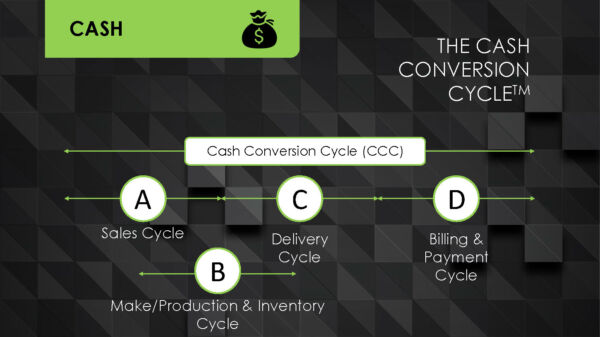
Many business owners focus almost exclusively on collecting receivables.
While faster collections certainly help, lasting improvements often come from improving the first three parts of the cycle: sales, make/production & inventory, and delivery. Those are the areas that permanently shorten the time your cash is tied up inside the business.
Your Team Sees Cash Leaks You Don’t
One of the best exercises you can do is ask your team a simple question: “Where are we wasting money?”
You’ll likely be surprised by the answers.
Employees often see small inefficiencies every day that leaders overlook. Individually, they don’t seem significant. Together, they subtly drain thousands of dollars from the business.
Including your team in improving cash flow also builds trust. Nothing frustrates employees more than hearing “We can’t afford raises” while watching waste around them every day. Invite them into the solution.
Your Strategy Is Cash
Every company wants to focus on growth, leadership development, technology, AI, recruiting, or expansion. But if cash is constantly tight, none of those will ever become the real strategy because the cash constraint is controlling everything.
Cash is a resource that enables you to acquire all the other resources your business needs.
It funds equipment. It funds technology. It funds great people. It funds innovation.
Cash gives you the flexibility to pursue opportunities instead of constantly reacting to emergencies.
At Assured Strategy, we often remind clients that when cash is constrained, strategy becomes limited. When cash is healthy, strategy becomes possible.
Grow on Purpose
Making money isn’t the finish line. Building cash reserves gives your business choices.
It allows you to weather downturns, invest confidently, hire exceptional people, and execute your strategy without constantly worrying about the next payroll or unexpected expense.
The goal is to keep enough cash so your business can grow intentionally and consistently, with the resources to deliver exactly what your customers need.
Don’t Wait
If you’re unclear on your cash flow, reach out to us today to schedule a Business Assessment or a Free Coaching Session.
We bring you insights from the summit.
Sign up for our newsletter today.
SELECT YOUR FREE OFFER




Upcoming Events

Coaching Programs
Upcoming Events