
Comparing EOS, OKRs, 4DX, and Scaling Up
An Honest Assessment from a 16-Year Scaling Up Coach
David Chavez
I’ve been coaching companies with Scaling Up for 16 years, but my journey with the system started long before that. I first encountered Verne Harnish in 2001, applied Scaling Up in my CPA firm in 2003, and sold that firm in 2007 after tripling its valuation in just three years. As a valuation expert who had completed over 100 equity deals, I was astonished at the measurable impact.
Since then, my firm has helped over 300 companies implement Scaling Up. What I’ve learned is that success with any system depends on the leadership team’s commitment to applying it consistently and adapting it thoughtfully. Tools and frameworks are just scaffolding—the real results come from disciplined execution and accountability.
With that context, here’s my honest take on EOS, OKRs, 4DX, and Scaling Up.
Entrepreneurial Operating System (EOS)
EOS is a discipline-based system that focuses almost entirely on execution. Its power lies in its simplicity: the tools are easy to understand, implement, and effective for instilling discipline and accountability. The core practices—Rocks (quarterly priorities), Level 10 meetings (weekly accountability check-ins), and the Vision/Traction Organizer (a two-page business plan)—are easy to understand, easy to implement, and effective for instilling discipline.
Implementers, however, aren’t always coaches in the truest sense. Many are facilitators and teachers who help companies follow the playbook. A few bring deeper business acumen, but EOS is designed to be uniform and prescriptive.
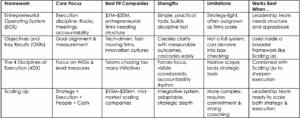
In my experience, EOS is best suited for entrepreneurial companies in the $1M to $20M range that must establish discipline, focus, and accountability habits. EOS helps owners “get control” of their business. The trade-off is that once a company scales into complex strategic challenges, EOS often feels limiting. Many businesses we’ve worked with started on EOS and found success but eventually outgrew it and needed something more strategy-driven, like Scaling Up.
Objectives and Key Results (OKRs)
Another discipline-based system, OKRs approach execution through goal setting. Popularized by Intel and later by Google, OKRs link ambitious Objectives with measurable Key Results, making goals tangible and trackable. They create alignment by ensuring that everyone, from leadership to front-line employees, knows precisely what success looks like.
OKRs shine in fast-moving, innovative-driven companies. They encourage teams to “shoot for the moon” while grounding ambition in metrics. Their most significant strength is simplicity—teams can quickly grasp and apply the concept across departments.
The limitation? OKRs are not a full operating system. They’re a goal-setting mechanism, not a complete framework for strategy or culture. OKRs risk becoming another “flavor of the month” management tool without a broader system around them. That’s why many of our clients use OKRs within Scaling Up. OKRs map naturally to Scaling Up’s “Rocks” and bring discipline to execution while Scaling Up provides the strategic depth.
The 4 Disciplines of Execution (4DX)
The 4 Disciplines of Execution (4DX), created by FranklinCovey, is also a discipline-first framework. It’s built on four principles:
1. Focus on the wildly important (the WIG).
2. Act on lead measures (the inputs that drive outcomes).
3. Keep a compelling scoreboard (make progress visible).
4. Create a cadence of accountability (regular team commitments).
The strength of 4DX lies in its ability to simplify focus. Too many leadership teams drown in competing initiatives; 4DX forces them to commit to fewer, more impactful goals. Its emphasis on lead measures and visible scoreboards builds strong team engagement. This is like Scaling Up, OKR, and EOS in driving fewer, more focused objectives.
But, like EOS and OKRs, 4DX is narrow in scope. It doesn’t address strategy, culture, or scaling complexity. Many companies come to us after trying 4DX and realizing it lacked the strategic structure they needed. Still, 4DX integrates beautifully with Scaling Up. The WIG concept mirrors Scaling Up’s Critical Number, and its accountability rhythms enhance its meeting structure.
At its best, 4DX is a powerful execution discipline—but it needs the scaffolding of a strategy-based system to drive growth truly.
Scaling Up
This is the system I’ve committed my career to coaching, and for good reason.
Unlike EOS, OKRs, or 4DX, Scaling Up is a strategy-based system designed for growth-stage and mid-market companies (typically $10M to $20M+). Its strength is bridging the gap between entrepreneurial chaos and sustainable scale.
Scaling Up is built on four decisions every company must make right: People, Strategy, Execution, and Cash. Practical tools like the One Page Strategic Plan, Function Accountability Chart, Rockefeller Habits Checklist, and the 7 Strata of Strategy provide both structure and flexibility.
What sets Scaling Up apart is its focus on the Core Customer, who drives optimal profit. Aligning strategy, execution, and business model around that customer creates clarity and lasting competitive advantage.
Another distinction: Scaling Up is integrative, not prescriptive. It creates space for companies to incorporate elements from other systems like OKRs or 4DX. It provides discipline and rhythm—quarterly priorities, daily huddles, and annual planning—while leaving room for customization. This adaptability is why many companies transition from EOS into Scaling Up as they grow.
Ultimately, Scaling Up is about more than execution: it is about building strategy, aligning culture, and generating predictable cash flow while scaling profitably. It offers the most complete framework for companies serious about growth and long-term value creation.
The Deciding Factor
Ultimately, all these systems can work—but only if the leadership team commits fully to implementation, accountability, and follow-through.
And there’s another overlooked factor: the quality of your guide. Whether you choose an EOS implementer, OKR facilitator, 4DX trainer, or Scaling Up coach, their business acumen and ability to challenge your team are as important as the framework itself. A facilitator helps you follow the playbook, but a true coach helps you think strategically, adapt wisely, and grow sustainably.
My Bottom Line
- EOS, OKRs, and 4DX: excellent for building discipline, alignment, and execution habits.
- Scaling Up: the system of choice for mid-market growth because it integrates strategy with execution, adapts to a company’s unique context, and builds long-term value.
After two decades of experience, I’m convinced that the Scaling Up framework is the most complete framework for companies that want to build strategy, scale execution, and maximize long-term value.
Here’s a quick comparison table for your reference.